What it is
Puerto José Banús — always just Puerto Banús — is a luxury marina in the Nueva Andalucía district, west of the center. It opened in May 1970 and quickly became one of the best-known places on the whole Costa del Sol.
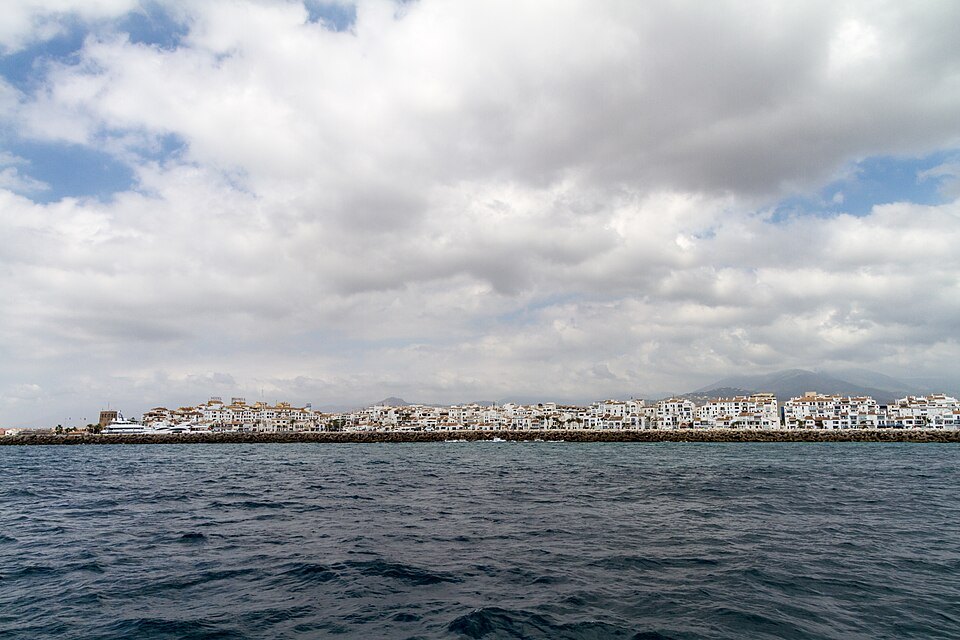
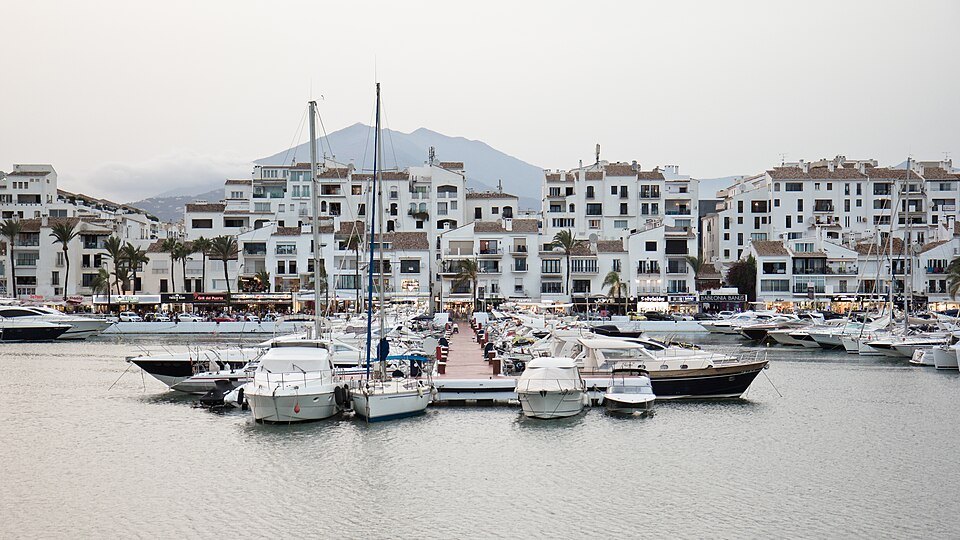
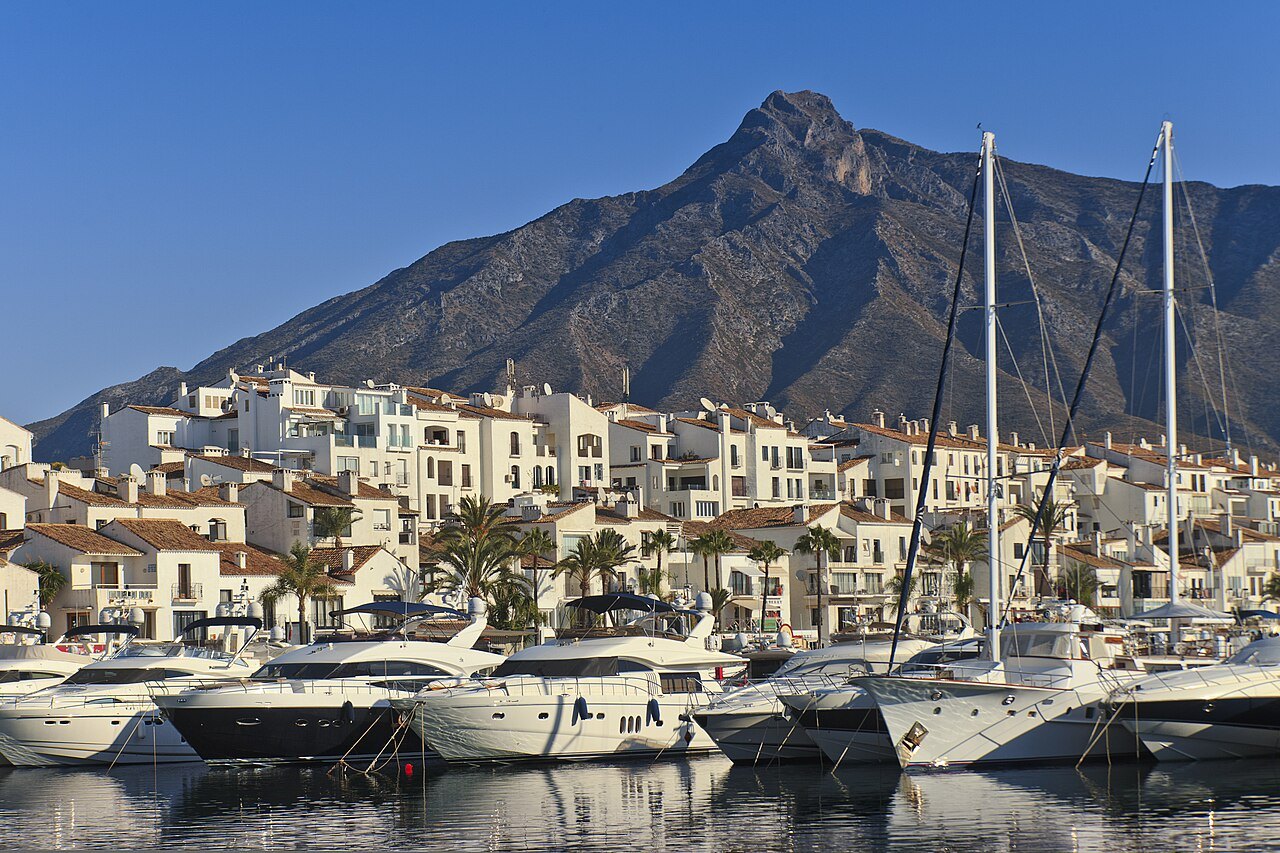
⭐ The interesting part is what it is not. The architect Noldi Schreck, together with Marcos Sainz, persuaded the developer José Banús not to build high-rise blocks but a low, white Andalusian village wrapped around the harbor. That decision is why it still looks the way it does.
What you see
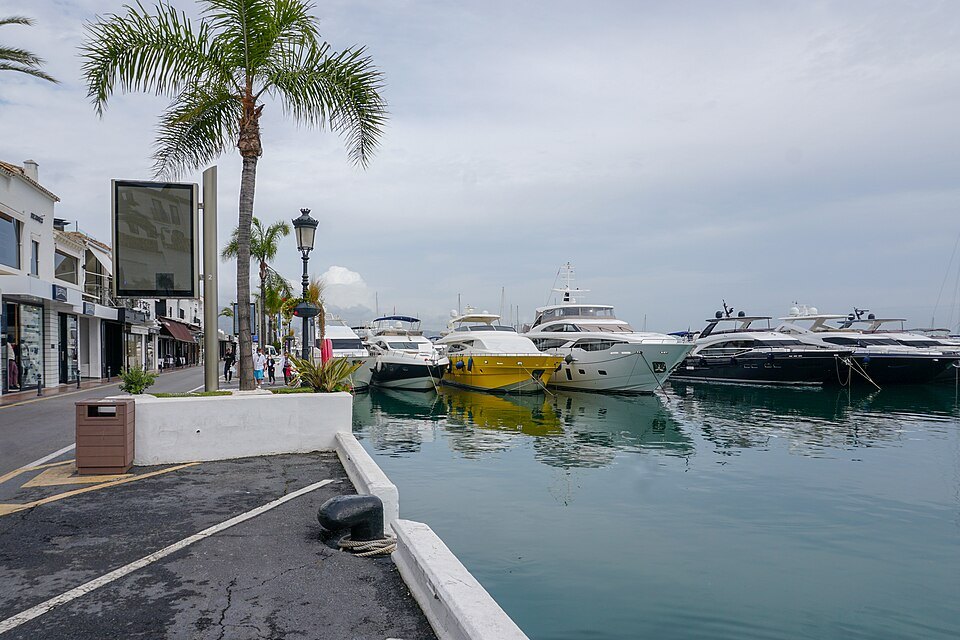
Very large yachts along the quays, designer shops in the ground floors behind them, the harbor lighthouses and control tower at the entrance, and a beach on either side.
Most people come to look — at the boats, at the cars that circle the quay, at each other. That is the entertainment, and it costs nothing to watch.
Getting it right
⭐ Come in the evening. The port is at its most itself after dark, and the walk there along the Paseo Marítimo in the late afternoon is the best way to arrive.
⚠️ In July and August the quay is very crowded and the bars price accordingly. If you want the harbor without the crowd, come in the morning.
How the village idea won
The story starts with the Marbella Club. In 1966 Prince Alfonso de Hohenlohe visited the architect Noldi Schreck, who had worked on the design and building of Beverly Hills, and asked him to design the hotel's beach club. That job brought Schreck to José Banús, the developer, and he set out to convince him that the new port should not be a cluster of skyscrapers. With the young Mexican-Spanish architect Marcos Sainz he proposed a harbor village on Andalusian lines instead, and the English Wikipedia article describes the result as the first port designed entirely by a single architectural team.
Banús adopted the plan, and the port took his name. He went on to become the largest developer of residential tourism on the Costa del Sol, and became known as the regime's builder for his closeness to Franco. The marina facilities themselves were modeled on the marinas of the French Riviera.
The opening night
The opening in May 1970 was a society event. Among the guests were the Prince and Princess of Spain, Juan Carlos and Sofía, Prince Rainier and Princess Grace of Monaco, the Aga Khan, Roman Polanski, Hugh Hefner and Christiaan Barnard, the pioneer of heart transplants. A young Julio Iglesias was hired to sing, three hundred waiters from Seville served the 1,700 guests, and the menu included 22 kilos of beluga caviar. The port won the Gold Medal for Tourist Merit in 1975, and later the Gold Mercury International award for its part in economic, cultural and social cooperation.
The Saudi connection
In the 1970s Salman bin Abdulaziz, then governor of Riyadh, and his brother Fahd began spending long periods on the Costa del Sol. On their first visit they booked 32 rooms at the Hotel Incosol for their entourage. Two years later they began building five palaces on the Golden Mile, and later they bought two berths in Puerto Banús, including the berth of honor where the Shaf London, a yacht 53 meters long that Salman bought in 1991, has moored since. The Gulf royal families have favored the port ever since.
Its success has drawn rivals: in 2011 a Qatari sheikh announced a large investment in La Bajadilla, the port on the east side of Marbella, with a quay for cruise ships, a hotel and shops meant to compete with Banús.
The harbor in numbers
The marina has 915 berths for boats from 8 to 50 meters long, inside 15 hectares of water protected by breakwaters, with a depth of three to six meters inside and more at the entrance. According to the town council it receives nearly five million visitors a year, mostly from northern Europe, above all Britain, and from the Gulf, along with Spanish and Russian visitors. Its sheltered position under the coastal mountains gives it a mild climate, with an average annual temperature of 64 °F (18 °C).
What else to look for
Behind the quays the streets are lined with the boutiques of the big fashion houses, and on the Antonio Banderas square is one of the largest El Corte Inglés department stores in Spain. The Boulevard de la Fama honors people who have promoted Marbella through their work.
Two large sculptures stand at the edges of the port. On one of the roundabouts at the entrance is Salvador Dalí's three-ton Rinoceronte vestido con puntillas, the rhinoceros dressed in lace, which he made in 1956 after filming his surrealist film about a lacemaker and a rhinoceros, and which was placed here in 2004. The other is La Victoria by the Georgian sculptor Zurab Tsereteli, a bronze and copper figure 26 meters high on a granite base, unveiled in 1994 as a gift from the mayor of Moscow.
Sources