What it is
In 1706 Tomás Francisco Domínguez y Godoy built a country house on the site of an older farm, part of his family's entailed estate. Alongside the living quarters he built a sugar mill, and later an oil mill was added.
The house was altered and extended over the years, and took roughly its present form in the first half of the 19th century — which is also when it began to be called Miraflores.
Why it matters
⭐ It is a surviving piece of the economy Marbella had before tourism: sugar cane, olive oil and farming. The town grew out to meet it, and it now sits inside the Pilar–Miraflores district rather than in the fields.
The same sugar economy is behind San Pedro Alcántara, founded as a colony in 1860.
Visiting
The cortijo is used by the town for exhibitions and cultural events, so what is inside changes. The courtyard and the buildings themselves are the constant.
A family estate
The farm was called the cortijo del Prado de San Francisco, and it belonged to an entailed estate founded by Melchor Domínguez, the grandfather of Tomás Francisco Domínguez y Godoy, who built the country house in 1706 on the remains of an old farmhouse. It came with fifty fanegas of farmland for fruit trees and olives. Beside the house he built an oil mill, a sugar mill and a wine cellar, as well as the living quarters.
The garden in front was laid out in 1756. The exotic species were introduced in 1850 by Tomás Domínguez Artola, intendant general of the Philippines, and the garden is still the first thing you notice: a lush mix of very different plants from far away. Antonio Domínguez Alburquerque gave the house its present structure in the first half of the nineteenth century, when the name Miraflores came into use. After Tomás Domínguez Artola died in 1886 the property left the family.
From olive mill to cultural center
By the early forties the cortijo belonged to Juan Lavigne Gutiérrez, a Marbella pharmacist, and the oil mill stopped pressing in 1959. After several changes of ownership it passed to the town council, which restored it as the Centro Cultural Cortijo Miraflores. It holds a steady program of temporary exhibitions, lecture series, film showings and recitals, and it also houses the Municipal Historical Archive.
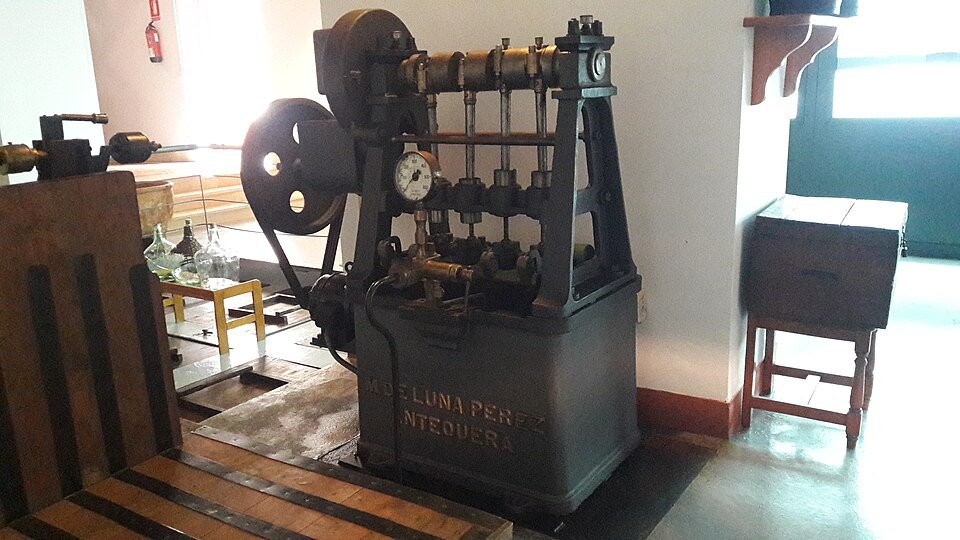
The nineteenth-century oil mill is kept as a museum, with a mill, a mixing machine and two hydraulic presses, and many of the old grinding machines and tools are in very good condition. The long hall at the back of the courtyard is used to display oil mills.
Reading the house
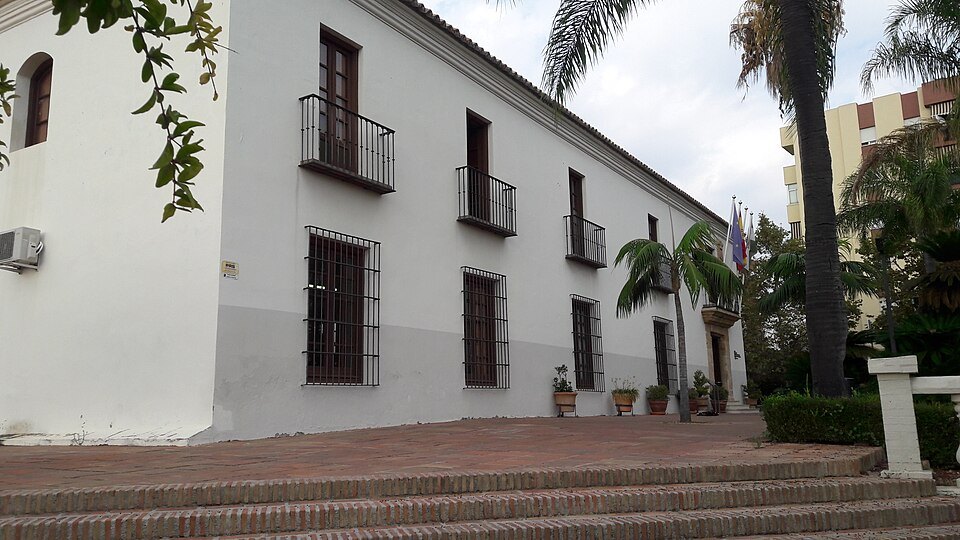
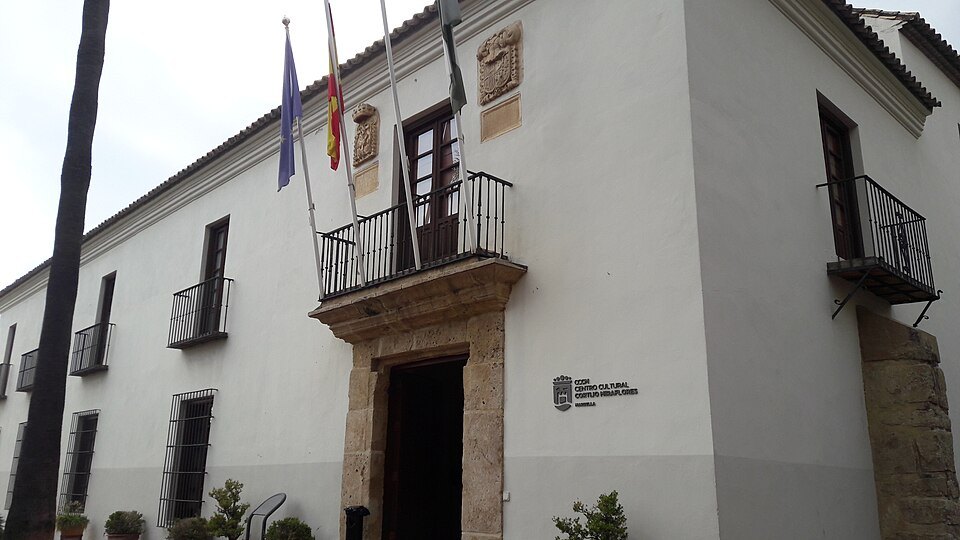
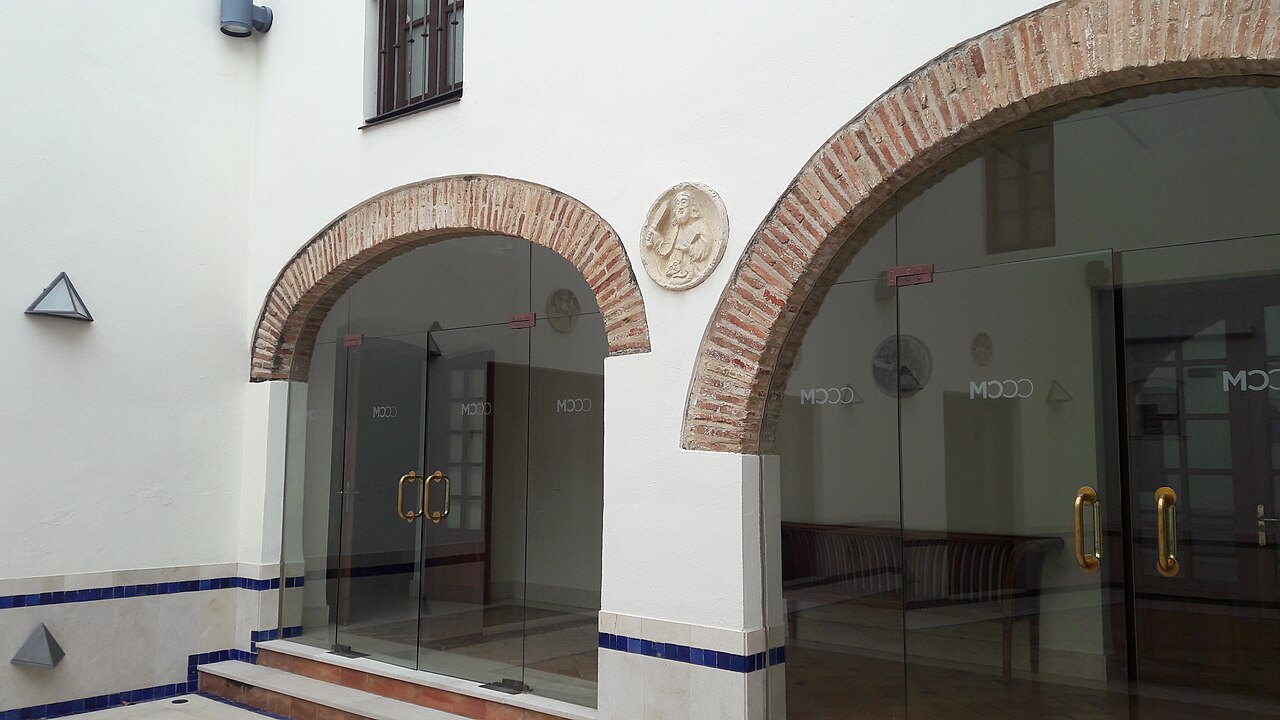
The house stands on top of the Cerro de San Francisco, surrounded by gardens and archaeological remains, with entrances from calle José Luis Morales y Marín and calle San Pedro Alcántara. It is square, with a central courtyard, a two-story main building and extra ranges added along the sides and the back. The front is plain, five openings wide, with the entrance in the one furthest to the right, framed by a sandstone doorway whose cornice carries a balcony on the first floor. Next to the balcony are two carved coats of arms, one of the Franciscan order and one of the Domínguez family. Around the courtyard runs a single range of rooms with an arcade of brick arches.
Inside, look for the medallions with saints, probably taken from older buildings, and a modern tile panel showing the Virgen del Pilar appearing to Saint James, which suits the name of the district outside. The building also has a Mudéjar timber ceiling that recalls the one in the council chamber of the town hall on the Plaza de los Naranjos.
Sugar in Marbella
Sugar cane came to Marbella from 1644 and spread along the whole coast of Málaga, bringing sugar mills with it. One of them, the Trapiche del Prado, was built that year on the slopes of the Sierra Blanca, north-east of the town, where a public water channel met the royal road. It ran a water mill and a mule mill until 1725, and it was almost entirely rebuilt and enlarged by Enrique Grivegnée between 1800 and 1808. The cortijo's own sugar mill belongs to the same story, which continued in the nineteenth century at San Pedro Alcántara.
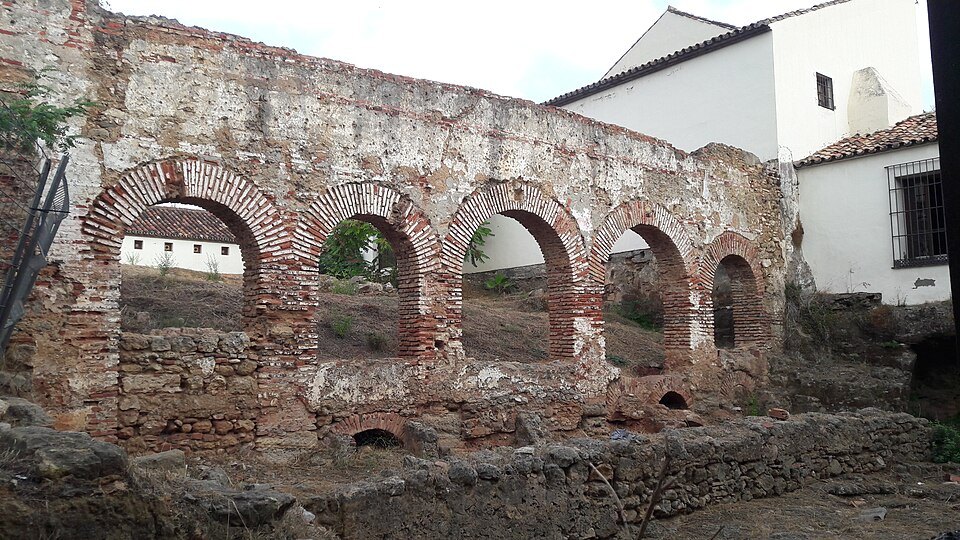
The heritage record for the Trapiche del Prado traces the whole process through its rooms. The cane was stripped and cut in a hall the Marbella documents call the Palacio de la Batalla, then crushed in the molienda, the first stage of making sugar. An excavation in 2009 found the platform and the two beds of the water-driven mill, and early in the nineteenth century Grivegnée seems to have added an innovative circular mill, ringed by a passage around which the animals walked to turn it.
Sources
- Cortijo de Miraflores — IAPH, Guía Digital del Patrimonio Cultural de Andalucía
- Trapiche del Prado — IAPH
- Cortijo de Miraflores — Wikipedia (es)
- Marbella — Wikipedia (es)